
IPTV vs Cable TV – Which One is Better in 2026?
The way people watch television has changed dramatically over the past decade. Traditional cable TV services were once the primary method for watching live channels, sports, movies, and entertainment programs. However, with the rapid development of internet technology, IPTV has emerged as a powerful alternative.
IPTV, or Internet Protocol Television, delivers television content through internet networks rather than through cable infrastructure or satellite signals. This modern streaming technology allows viewers to access thousands of channels and on-demand content from almost anywhere in the world.
As internet speeds continue to improve and streaming platforms evolve, more households are switching from cable TV to IPTV services.
If you want to explore a modern IPTV streaming platform, you can visit:
In this article, we will compare IPTV and cable TV in detail to determine which option offers the best entertainment experience in 2026.
What is Cable TV?
Cable TV is a traditional television system that delivers television channels through physical cable networks.
Cable providers transmit television signals through coaxial or fiber optic cables connected to homes. Users subscribe to monthly packages that include a certain number of channels.
Cable TV has been the dominant television system for decades, providing access to news channels, sports networks, entertainment programs, and local broadcasts.
However, cable television has several limitations that have led many viewers to look for alternatives.
Some of the common limitations include:
Limited channel selection
High subscription costs
Fixed viewing locations
Lack of on-demand flexibility
These limitations have contributed to the growing popularity of IPTV.
What is IPTV?
IPTV stands for Internet Protocol Television. Instead of transmitting television signals through traditional broadcast systems, IPTV delivers content through internet networks.
This allows users to stream television channels, movies, and series directly on their devices.
IPTV services provide several key features including:
Live TV streaming
Video on demand
Catch-up TV
Multi-device compatibility
High-definition streaming
Because IPTV uses internet technology, it allows viewers to access global content without geographical limitations.
Many IPTV users enjoy services like:
which provide thousands of channels and high-quality streaming.
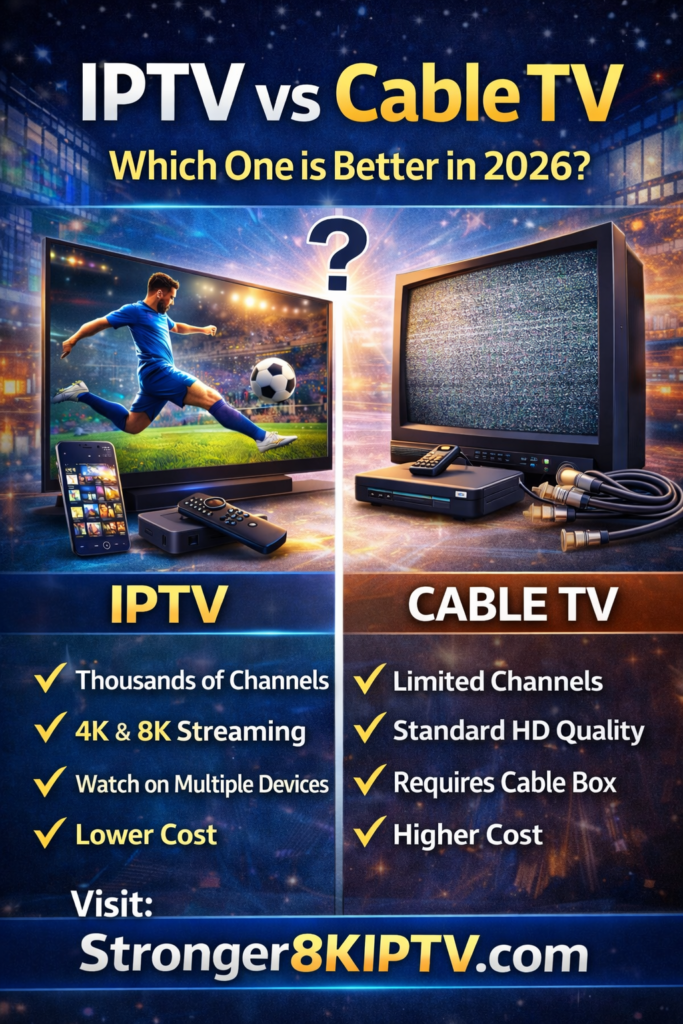
IPTV vs Cable TV – Major Differences
To understand why IPTV is becoming more popular, it is helpful to compare the key differences between IPTV and cable television.
Content Availability
Cable TV providers usually offer a limited number of channels based on regional broadcasting agreements.
IPTV services often provide access to thousands of channels from different countries around the world.
This allows users to watch international content including sports events, entertainment shows, and news broadcasts.
Streaming Quality
Cable television often provides standard HD streaming quality.
IPTV services frequently offer much higher video resolutions such as:
Full HD
4K Ultra HD
8K Ultra HD
Higher streaming quality improves the viewing experience, especially on large modern televisions.
Device Compatibility
Cable TV usually requires a cable box connected to a television.
IPTV services can be accessed on multiple devices including:
Smart TVs
Android TV boxes
Amazon Firestick
Smartphones
Tablets
Computers
This flexibility allows users to watch content anywhere.
Cost Comparison
Cable TV subscriptions can be expensive, especially when premium channels are included.
IPTV subscriptions are often more affordable while providing access to more content.
This affordability is one of the main reasons why many users switch to IPTV.
Advantages of IPTV
IPTV offers several advantages that make it attractive for modern viewers.
Global Channel Access
One of the biggest advantages of IPTV is access to international channels.
Users can watch content from multiple countries without needing separate cable packages.
Video On Demand
IPTV platforms often include large libraries of movies and TV series.
Users can choose content and start watching instantly instead of waiting for scheduled broadcasts.
Multi-Device Streaming
IPTV allows users to watch content on multiple devices simultaneously.
For example:
Watching sports on a TV
Watching movies on a tablet
Watching news on a smartphone
This flexibility makes IPTV ideal for families.
Flexible Viewing
Unlike cable TV, IPTV allows viewers to watch content anytime.
This flexibility fits modern lifestyles where people prefer on-demand entertainment.
Advantages of Cable TV
Although IPTV has many advantages, cable TV still has some benefits.
Stable Broadcast Signals
Cable TV signals are usually stable and do not depend on internet connections.
This can reduce buffering issues.
Local Channels
Cable providers often include local channels and regional broadcasts.
These channels may include local news and community programming.
Simple Setup
Cable TV is easy to install and usually requires only a cable box and television.
However, IPTV installation is also relatively simple.
Why Many People Are Switching to IPTV
The number of IPTV users has increased significantly in recent years.
Several factors have contributed to this shift.
Faster Internet Speeds
High-speed internet connections are now widely available in many regions.
This allows users to stream high-quality video content without interruptions.
Growth of Streaming Culture
Modern audiences prefer streaming services because they provide more control over what they watch.
IPTV fits perfectly into this streaming culture.
Affordable Entertainment
IPTV services often provide thousands of channels and movies at lower subscription costs.
This makes IPTV more attractive than traditional cable packages.
How to Start Watching IPTV
Getting started with IPTV is simple.
Step 1 – Choose an IPTV Provider
Choose a reliable IPTV provider that offers stable streaming and large content libraries.
You can explore:
Step 2 – Install an IPTV App
Install an IPTV player application on your device.
Popular IPTV apps include:
IPTV Smarters
TiviMate
XCIPTV Player
Step 3 – Enter Login Details
Enter your IPTV subscription credentials.
The IPTV player will load your channel list.
Step 4 – Start Streaming
Browse available channels and start watching live TV instantly.
IPTV Internet Speed Requirements
For the best IPTV experience, users need a stable internet connection.
Recommended speeds:
SD streaming
5 Mbps
HD streaming
10 Mbps
4K streaming
25 Mbps
8K streaming
50 Mbps or more
Faster internet speeds provide smoother streaming.
Future of IPTV vs Cable TV
The television industry is evolving rapidly.
Many experts believe IPTV will eventually replace traditional cable television.
Several technological trends support this prediction.
Fiber internet expansion
5G mobile networks
Improved streaming technology
Global content distribution
These developments make IPTV more powerful and accessible.
Why Stronger8K IPTV Is a Powerful IPTV Platform
When choosing an IPTV service, it is important to select a provider that offers reliable servers and high-quality streaming.
Stronger8K IPTV focuses on delivering a modern IPTV experience.
You can explore the platform here:
The service provides:
Thousands of live channels
Movies and TV series libraries
HD, 4K, and 8K streaming
Fast and stable servers
Multi-device compatibility
These features make it a strong option for IPTV users.
Final Conclusion
IPTV and cable TV both provide access to television content, but IPTV offers several advantages that make it more suitable for modern viewers.
With global channel access, high-definition streaming, and flexible viewing options, IPTV provides a powerful alternative to traditional cable television.
As internet technology continues to improve, IPTV will likely become the dominant method of television streaming worldwide.
If you want to explore a modern IPTV streaming platform, visit:
and discover a powerful IPTV service designed for high-quality entertainment.
User Experience: IPTV vs Cable TV
User experience is one of the most important factors when choosing between IPTV and cable TV. Modern viewers expect fast, flexible, and easy access to entertainment content.
Cable television offers a simple experience where users can switch channels using a remote control. However, the interface is usually limited and does not offer advanced features.
IPTV services provide a much more modern user interface. Most IPTV platforms include smart navigation systems that allow users to browse thousands of channels quickly.
Users can search for specific channels, movies, or TV shows using built-in search tools.
Many IPTV platforms also allow users to create personalized watchlists, organize favorite channels, and receive content recommendations based on their viewing preferences.
This type of personalization makes IPTV platforms feel more similar to streaming services such as Netflix and other modern entertainment platforms.
IPTV Content Variety
One of the biggest advantages of IPTV services is the massive variety of available content.
Cable TV providers usually offer channel packages that include a limited number of networks.
These packages are often restricted to local or regional channels.
IPTV services, on the other hand, can offer content from all around the world.
Users can access channels from different regions including:
North America
Europe
Asia
Middle East
Africa
This global access allows users to watch international sports, news, movies, and entertainment programs that may not be available through traditional cable TV.
Many IPTV services also include premium movie channels and large libraries of on-demand content.
This variety makes IPTV much more appealing for viewers who want unlimited entertainment options.
IPTV Streaming Technology
IPTV technology relies on advanced internet streaming systems to deliver content efficiently.
Instead of broadcasting signals through cables or satellites, IPTV providers store video content on powerful servers.
When a user selects a channel or movie, the IPTV server sends the video stream directly to the user’s device.
This streaming method allows for faster content delivery and better video quality.
Modern IPTV services support several streaming formats including:
Standard Definition
High Definition
Full HD
4K Ultra HD
8K Ultra HD
These formats allow viewers to enjoy crystal-clear video quality.
High-quality IPTV providers invest heavily in server infrastructure to ensure smooth streaming without buffering.
Cable TV Infrastructure
Cable TV relies on physical infrastructure to transmit signals.
Television signals travel through cable networks that connect broadcasting stations to homes.
Although cable infrastructure is stable, it can be expensive to maintain and upgrade.
Cable providers must constantly maintain large networks of cables and broadcasting equipment.
Because of these infrastructure costs, cable TV subscriptions are often more expensive than IPTV services.
In addition, cable networks may not easily support newer streaming technologies such as ultra-high-definition video formats.
This technological limitation makes it harder for cable providers to compete with internet-based streaming services.
Installation Process
Another difference between IPTV and cable TV is the installation process.
Cable TV installation usually requires a technician to install cable connections and configure a cable box.
This process can sometimes take several hours and may require additional equipment.
IPTV installation is much simpler.
Users only need to install an IPTV application on their device and enter their subscription credentials.
Once the IPTV player loads the channel list, users can start watching immediately.
This simple installation process makes IPTV more convenient for many users.
IPTV for Modern Smart Homes
Smart homes are becoming more common as technology continues to advance.
Many households now use smart TVs, streaming devices, and connected home entertainment systems.
IPTV services integrate perfectly with these modern devices.
Users can access IPTV streaming through smart TVs, voice-controlled assistants, and mobile applications.
This integration allows IPTV platforms to provide a seamless entertainment experience.
Cable TV systems often struggle to keep up with these modern technologies.
As smart home technology continues to expand, IPTV will likely become the preferred entertainment solution.
Environmental Impact
Another interesting factor when comparing IPTV and cable TV is environmental impact.
Cable TV infrastructure requires large networks of physical cables and broadcasting equipment.
Maintaining this infrastructure consumes energy and resources.
IPTV systems rely primarily on digital streaming servers and internet infrastructure.
Although servers still require energy, IPTV systems generally require less physical infrastructure than cable networks.
As technology evolves, streaming services may become more energy efficient.
This could make IPTV a more environmentally friendly option for digital entertainment.
IPTV for International Users
One of the most attractive features of IPTV is its global accessibility.
Cable TV services are usually limited to specific regions.
For example, users traveling to another country may not be able to access their cable TV subscriptions.
IPTV services work through internet connections, which allows users to access content from almost anywhere in the world.
This makes IPTV extremely useful for international viewers.
People living abroad can watch television channels from their home countries through IPTV services.
This global access is one of the main reasons why IPTV continues to grow in popularity.
IPTV and Sports Streaming
Sports fans are among the largest groups of IPTV users.
Traditional cable TV often restricts sports broadcasts to specific channels or regional networks.
IPTV services can provide access to sports channels from multiple countries.
This allows fans to watch international tournaments, leagues, and competitions.
Sports fans can enjoy live broadcasts of events such as:
Football matches
Basketball games
Tennis tournaments
Formula 1 races
Boxing fights
UFC events
The ability to access global sports channels is one of the biggest advantages of IPTV.
IPTV for Movies and Series
Another major benefit of IPTV is access to large movie libraries.
Many IPTV services provide extensive collections of movies and television series.
Users can browse categories such as:
Action movies
Comedy movies
Drama movies
Horror films
Documentaries
Kids movies
These libraries are often updated regularly to include new releases.
This makes IPTV platforms very appealing for viewers who enjoy movies and TV shows.
Frequently Asked Questions
Is IPTV better than cable TV?
For many users, IPTV offers more flexibility, better streaming quality, and access to more content than traditional cable TV.
However, the best option depends on personal preferences and internet connection quality.
Do I need fast internet for IPTV?
Yes. A stable internet connection is important for IPTV streaming.
Faster internet speeds provide smoother playback and higher video quality.
Can IPTV work on multiple devices?
Yes. IPTV services can be used on smart TVs, smartphones, tablets, and computers.
Many IPTV platforms support streaming on multiple devices simultaneously.
Is IPTV the future of television?
Many experts believe IPTV will become the primary form of television streaming as internet technology continues to improve.
Why Stronger8K IPTV Is a Powerful IPTV Solution
When choosing an IPTV service, it is important to select a provider that offers reliable streaming and high-quality content.
One modern IPTV platform designed to deliver a powerful streaming experience is:
The platform offers several key features including:
Thousands of live TV channels
Large movie and TV series libraries
High-quality HD, 4K, and 8K streaming
Fast and stable streaming servers
Compatibility with multiple devices
These features make it a strong choice for users who want a modern IPTV entertainment experience.
Final Conclusion
The comparison between IPTV and cable TV shows that IPTV provides several advantages for modern viewers.
With greater flexibility, higher streaming quality, and access to global content, IPTV offers a powerful alternative to traditional cable television.
As internet speeds continue to increase and streaming technology improves, IPTV will likely become the dominant form of television entertainment worldwide.
For users who want to explore a modern IPTV streaming platform, visit:
and discover a high-quality IPTV experience designed for the future of digital entertainment.